The Real Infrastructure Isn't the App. It's the People! - From NIPUN Maharashtra Archives
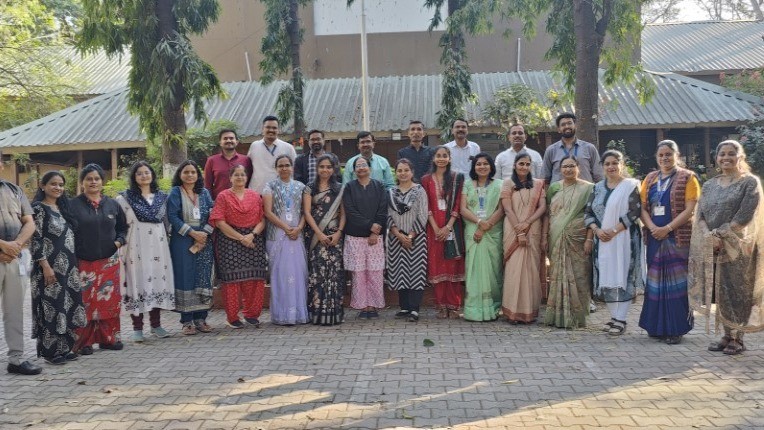
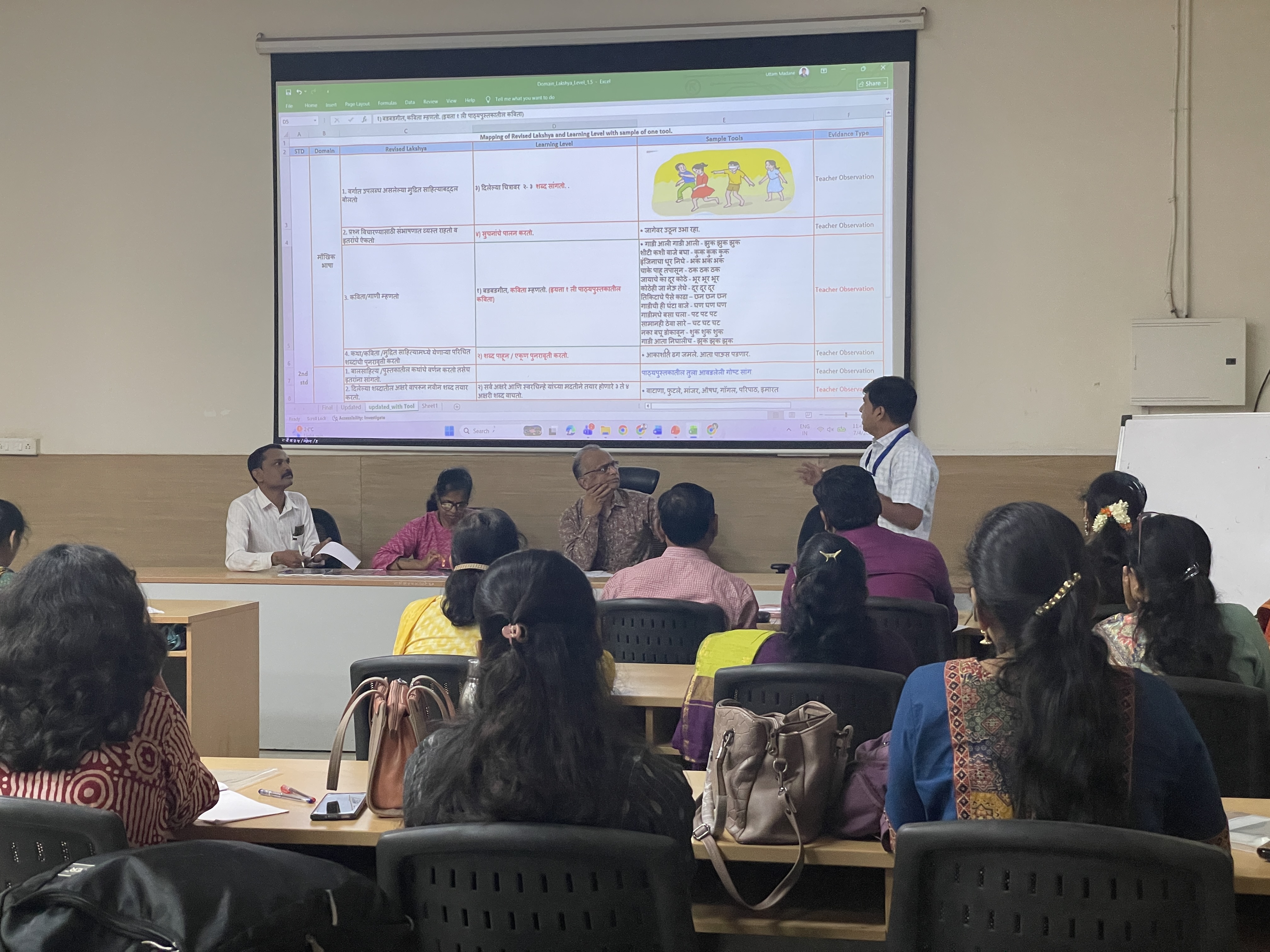
On the 4th and 5th of July, teachers from across Maharashtra gave up their weekend to work with SCERT and our team on finalising learning levels for the upcoming NIPUN Maharashtra assessment. A few days later, one of them sent us an unsolicited message saying that she had often been part of the chorus blaming “the team” whenever the assessment app misbehaved in her classroom, but watching the process from inside had changed her mind: “Teamwork should look exactly like what I saw over those two days. Hats off to you all.” That message stayed with me because it captured something larger than a successful workshop. Good assessment systems are not built by technology alone; they are built when teachers, experts, government officers and implementation teams sit at the same table, question their assumptions, test their work against classroom realities and keep showing up. Maybe that is the real infrastructure—not just the app, but the people willing to build, check and improve it together.
The message
On the 4th and 5th of July, a group of teachers from across Maharashtra gave up their Saturday and Sunday to sit in a room with SCERT and our team, finalising learning levels for the upcoming NIPUN Maharashtra assessment. A few days later, one of them wrote to us, unprompted.
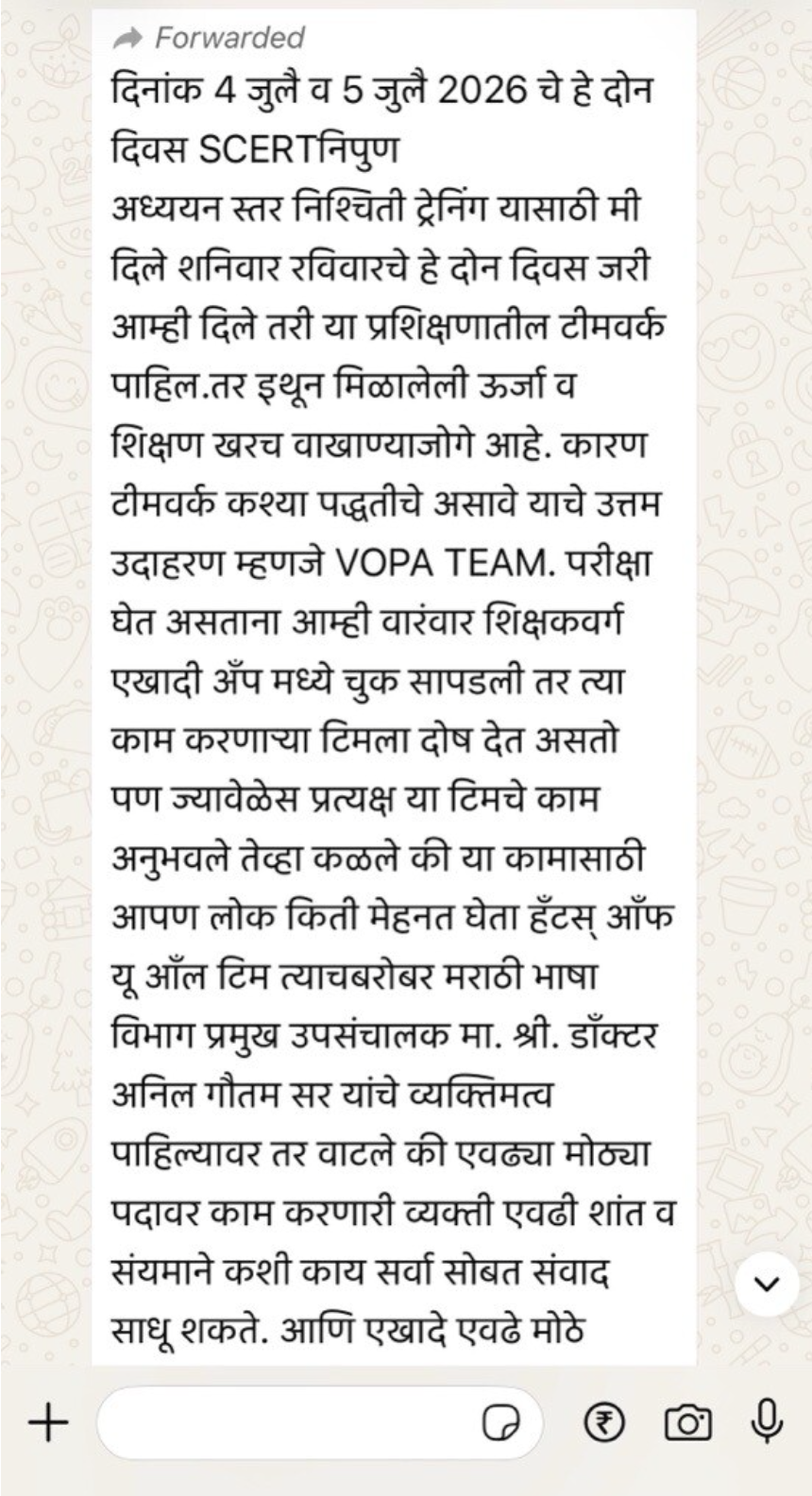
She said she had often been part of the chorus blaming "the team" whenever she thought the assessment app misbehaved in her classroom. Watching us work in that room changed her mind. Teamwork, she wrote, should look exactly like what she saw over those two days, and called it "hats off to you all", her words, not a phrase we asked her to use. She singled out her colleague Shinde sir too, describing him as someone who brought both humour and scholarship into the room.
And then she wrote about someone outside our team, which is the part that stayed with me longest. What she noticed most was the conduct of Dr. Anil Gautam, Deputy Director heading the Marathi language division at SCERT, working through both days, including a Sunday, without once losing his patience with the group. She wrote that officers, in her experience, usually visit a training to offer a few words of encouragement and leave. This one stayed and worked, calmly, beside teachers, the whole time.
Teamwork should look exactly like what I saw over those two days. Hats off to you all.
I did not write that sentence. A teacher did, because she noticed it and it mattered enough to her to say so.
That message stayed with me, because it is not the kind of thing you can plan for or ask for. It happens only when the room is actually built the way it looked from outside. Teachers, a government officer, and our team doing the same unglamorous work at the same table, on a weekend nobody was required to give up.
It happens only when the room is actually built the way it looked from outside.
Where this practice began
This was not the first time we built a room like that. We did the same thing in December too. Teachers from across the state, three days, two subjects, reading and writing, working in groups to build assessment tools for grades 1 through 5. That workshop alone produced more than 4,000 tools. And it taught us something we carried into July: teachers are not the end users of an assessment system. Done right, they are its first authors.
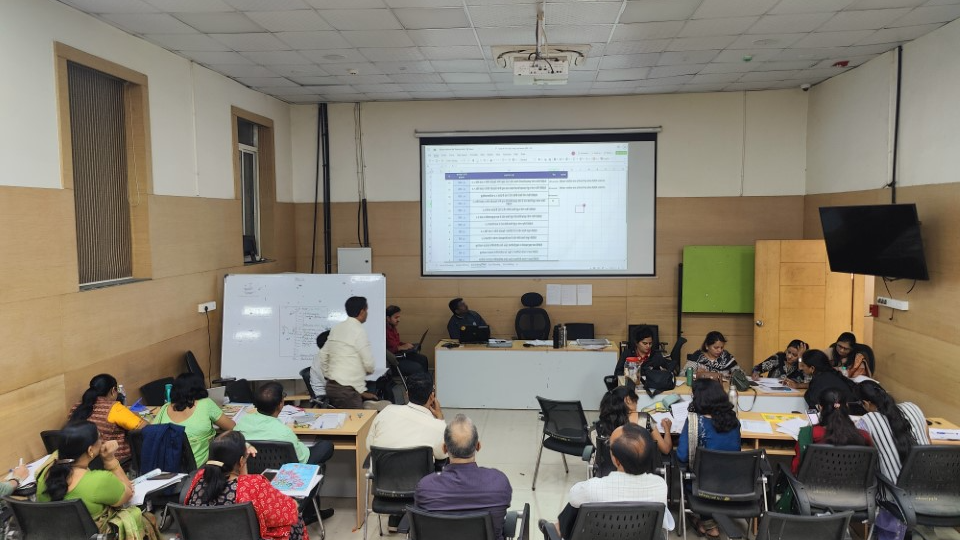
I want to sit with that December number for a moment, because it is easy to read past it. Four thousand tools is not four thousand documents. Each one is a small, precise decision about what a child should be asked to read or write at a specific level of difficulty; decisions that, done carelessly, can tell a government a child has failed when the tool has actually failed the child.
We did not build these in an office in Pune and hand them down to schools. We built them with the people who stand in front of children every day, and then had them review each other's work in rotating groups, so that no tool went unchecked by another teacher's eyes.
Teachers are not the end users of an assessment system. Done right, they are its first authors.
What teacher knowledge alone could not catch
But teacher knowledge alone was never going to be enough, and we knew that going in. Building an assessment item that looks simple, five words, one sentence, a picture.. is a much harder linguistic problem than it appears. After the December workshop, we brought in Manasee Mahajan, a language and literacy expert with more than twenty years of experience in foundational literacy and children's reading culture, to review what the teachers had built.
Manasee and Prajakta Panchal worked together and what came back became a guideline that now governs every reading and writing tool in the app. Eight principles, each one earned from finding where the existing tools had quietly gone wrong.
Confusable consonant clusters ग and घ, त and थ sitting in the same tool, so a child who mishears one is marked as unable to read, when the real problem was that we put two similar-sounding sounds next to each other. Letters that look alike on the page त, न, म, भ. A word like जून, which can mean "June" or "old," depending on nothing the child can control. None of this is carelessness. It is the ordinary difficulty of writing for six-year-olds at scale, visible only when someone with the right expertise goes looking for it.
Some of it was about who gets represented in a worksheet; a guideline that says stop writing sentences where cooking is always the mother's job and stepping outside is always the man's. Some of it was about geography and class. A sentence like "don't burn firewood, it causes pollution" is reasonable in a city and quietly shaming in a village where firewood is the only fuel a family has.
Fairness in assessment is not an abstract value. It is a line-by-line editorial discipline.
What the classroom told us that the design table couldn't
Between December and July, Abhishek Kaginkar Rohit Thakur and others from our team also went and looked at what was actually happening in classrooms. Our team travelled to Nashik, Wardha, and Chandrapur, not to present the tools but to watch them being used. We visited 15 schools, assessed close to 150 children ourselves and checked how closely our numbers matched what teachers had recorded in March.
What we found was not always comfortable; students shown an item before the microphone was switched on, a student who couldn't read quietly swapped for one who could, teachers who knew about the assessment feature of the app and nothing else it offered. None of it was malice. It was the predictable result of a system rolled out fast, without enough time spent training the people asked to run it.
That is the same lesson, showing up in three different rooms. The teachers who built the tools in December needed a language expert to catch what they could not see alone. The teachers using the tools in the field needed more training than they had received. And the teachers who sat through the July level-finalisation training gave us the clearest sign yet that when the process is built right, people notice and they tell you, even when you didn't ask.
Good design and good implementation are two different disciplines. A system that only invests in one will eventually be undone by its neglect of the other.
Where this goes next
We are now working with SCERT's language and mathematics teams to reduce the number of learning levels across reading, writing, numeracy, and numerical operations, and to make each level workable in an actual classroom, not just on a design document. Sample tools based on this simplified structure are already being built. The July training was a part of that process, not separate from it.
I keep returning to one thought from all of this. We often talk about assessment as if it were a technical problem; get the algorithm right, get the interface right, and the rest follows. It isn't!
Every one of those tools, from December to July, was a judgment call, made by a teacher who knows what a nine-year-old in her classroom can actually do, refined by an expert who knows how language traps children who did nothing wrong, tested against a reality we only understood because we went and looked, carried by a team willing to spend a weekend earning the description "hats off to you all" instead of just hearing it, and carried forward by a government officer willing to give up his Sunday the same way the teachers were giving up theirs.
Maybe that is the real infrastructure. Not the app. The people willing to keep showing up, checking their own work against the classroom, and against each other.
(to be continued)