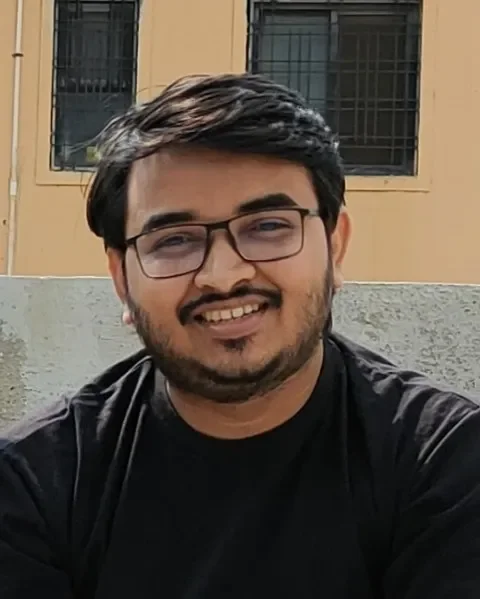
Prafulla Shashikant
Built digital public infrastructure used across 70,000+ schools in Maharashtra
Prafulla Shashikant is a Social Impact Systems Architect working at the intersection of education, technology, and public systems.
With a foundation in critical pedagogy and classroom practice, he has led hundreds of teacher capacity-building programs and designed curricula across teacher training, lesson planning, value education, life skills, and youth development. This on-ground experience informs his larger work: building systems that actually function in real classrooms.
At VOPA, he has architected large-scale digital platforms used by millions of students, teachers, and government institutions across Maharashtra. His approach integrates system design, product thinking, and user experience into solutions that are not only technically sound but deeply aligned with user realities.
His work focuses on solving one of the hardest problems in public education: making technology usable and effective in low-resource environments. Every platform is designed for conditions often ignored by mainstream systems like low bandwidth, shared devices, multilingual users, and institutions where adoption depends on trust, not just access.
Timeline
A life built around refusing to postpone meaningful work.
Education was not a privilege in Ambajogai; it was a pathway to dignity, survival, and duty. Growing up in a marginalised Dalit community and navigating a system not designed for people like him became the foundation of his later work in public systems. Prafulla was trained as a Mechanical Engineer at the Government College of Engineering, Aurangabad (Chh. Sambhaji Nagar). His socially active years in Aurangabad deepened his understanding of social issues, justice, and responsibility, shaping the lens through which he would later approach education and public systems.
While preparing for the civil services, Prafulla cleared the mains exam in his first attempt and was part of a preparation batch at YASHADA, Pune, while also pursuing an MA in Economics. During this time, his mother was diagnosed with cancer. He spent a year by her side, but all efforts failed. That loss led him to a clear decision: not to postpone meaningful work. He stepped away from a conventional career path and moved directly into social development. His mother's teachings remain a deep and lasting motivation for him.
Prafulla spent nearly six years as a full-time worker under the mentorship of Dr. Abhay Bang at SEARCH, Gadchiroli and MKCL, Pune on various development projects. He also completed the PGPDM course at SPJIMR, Mumbai. This period further shaped his understanding of systems-oriented, evidence-based, community-rooted development, and what it takes to build lasting change.
Starting a non-profit was never the plan. After SEARCH, motivated by the desire to put his knowledge to use for the most deprived, Prafulla spent six months searching for the right path, meeting experts, social reformers, activists, and monks. He could not find mentors willing to take on his bold and ambitious ideas of social change. During this time he volunteered with Dr. Anand Karandikar on the initial setup of Vicharvedh, and with other NGOs, supporting people through their own journeys. With encouragement from family and friends at a tipping point, he chose to build the organisation he could not find.
The journey began with two friends joining VOPA. Early work focused on the most deprived schools, teachers, and children, including HIV-affected children, children of sugarcane cutting migrant workers, and communities that mainstream education programmes could not reach. Prafulla designed teacher training sessions, capacity building workshops, school transformation materials, teaching skills programmes, school management practices, and value education curricula. This grassroots period, working directly with school stakeholders from the most marginalised sections of society, became the foundation on which all of VOPA's later programmes were built.
When the pandemic collapsed schooling into WhatsApp groups, Prafulla led the design of V-School, built on the conviction that teachers should be the creators of digital learning content. He personally trained thousands of teachers to produce values-driven digital educational resources, with a strong emphasis on female teacher participation. Together with these teachers, the complete State Board syllabus was created across Marathi, Semi-English, and Urdu mediums. Free, offline-first, and available in all three mediums, V-School later evolved into a full learning app reaching over 3 million users across Maharashtra. These efforts were supported by Edumentum, Unltd India, and the ACT Grant.
From a young age, Prafulla was deeply influenced by the writings and values of Dr. Narendra Dabholkar, whose thinking shaped his approach to rational thought and social responsibility. Recognising that mental health education was largely absent in the schools VOPA worked with, Prafulla collaborated with Dr. Hamid Daburkar, Director of Parivartan Trust, Satara, to build MYCA, a platform for mental health education, awareness, and support in Marathi for common people. Built with privacy and age-appropriateness as core design principles, MYCA made mental health resources accessible in the user's own language. A dedicated section for teachers' mental health was later integrated into the same platform, extending its reach to the very people who sustain schools every day.
Over time, V-School evolved into a super app with features for students, parents, teachers, and government officers, including the ability to conduct FLN assessments at the district level, which was adopted by many districts across Maharashtra. This technology caught the attention of SCERT, Maharashtra, who approached VOPA and collaborated to scale V-School's FLN assessment capability to the entire state as a dedicated mission. VOPA became the technology and knowledge partner for Mission NIPUN Maharashtra, the Government of Maharashtra's statewide initiative to ensure every child achieves foundational literacy and numeracy by Grade 3. Prafulla architected and managed the product design and user experience for an AI-powered assessment platform now covering 38 lakh students across 70,000+ schools, integrated with state data systems SHALARTH and SARAL.
Inspired by his own marriage, in which Prafulla and his wife exchanged vows without any religious ritual and placed the Constitution of India at the centre of their oath-taking ceremony, Prafulla designed and built Viveki-Vivah, a matrimonial platform created specifically for inter-caste and inter-religious marriages. His simple wedding ceremony, completed for under one lakh rupees in 2016, reflected a deep conviction that love and compatibility, not caste or religion, should guide the choice of a life partner. Hundreds of citizens who share this belief now use the platform to find a suitable partner. Viveki-Vivah is initiated and managed by Dr. Mukta Dabholkar, Hamid Dabholkar, and their colleagues.
Prafulla designed the SAIYAM Olympiad, both its project design and the digital platform that powers it, as a programme for addiction prevention and value formation among adolescents. Rooted in the principles of experiential learning, value education, and learning while doing, SAIYAM integrates education with real-world action through poster-making, street plays, awareness rallies, and structured group activities. Implemented in partnership with DIET Pune, Pune Municipal Corporation, Samagra Shiksha Abhiyan, Parivartan Trust, and Tarachand Ramnath Seva Trust, the programme reaches students across government schools in Pune and surrounding regions.