
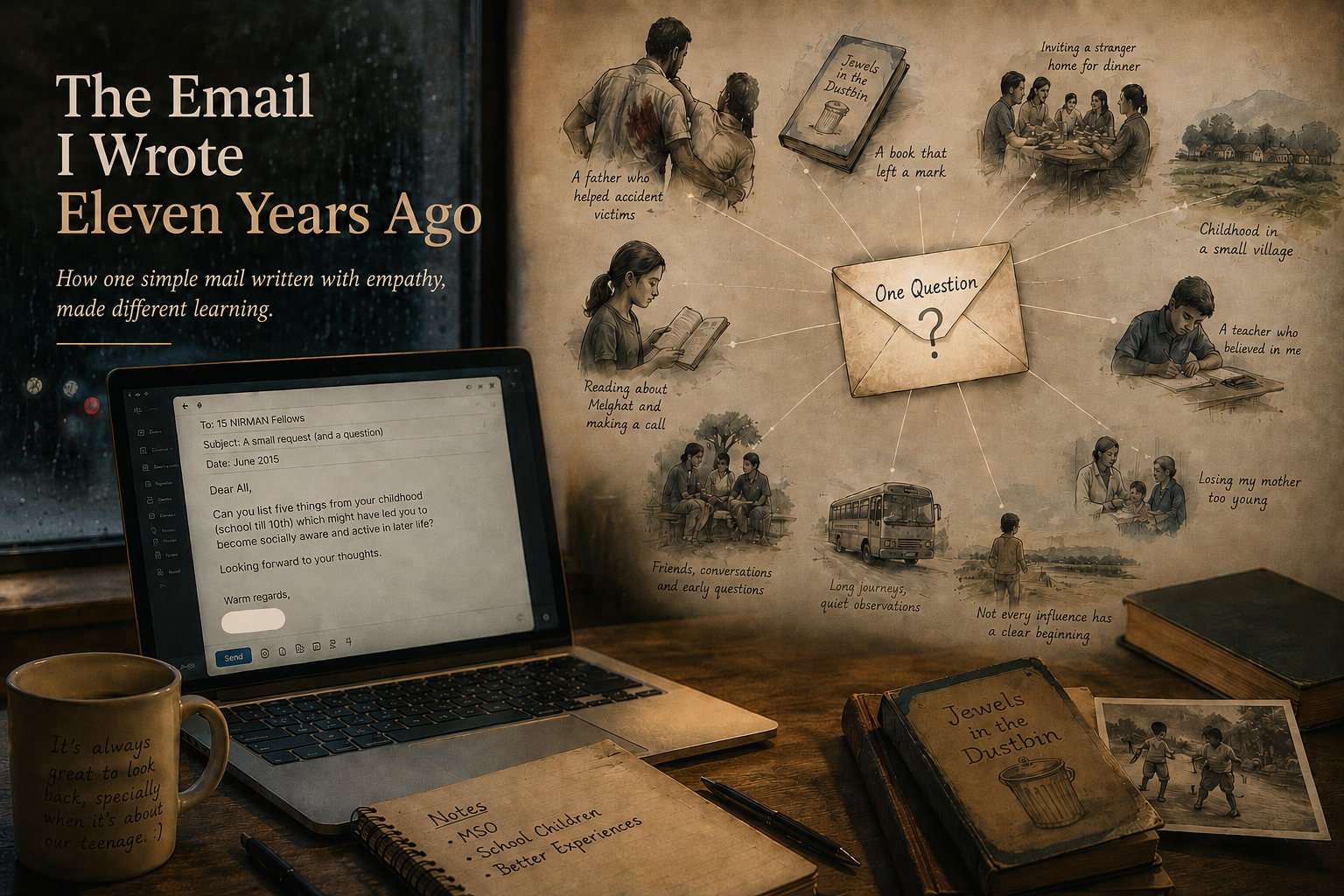
The Email I Wrote Eleven Years Ago
In June 2015, while working on the Maharashtra Social Olympiad, one question kept bothering me: Why are some children socially sensitive while others are not? Instead of turning it into a formal survey, I wrote a personal email to fifteen NIRMAN fellows, asking them to share five childhood experiences that might have shaped their social awareness. Twelve replied, and what came back was far more than answers: stories of parents helping strangers, books that opened new worlds, teachers who went beyond the syllabus, childhood questions that took years to find answers to, and experiences whose meaning became clear only in hindsight. That simple email became my first experiment in understanding how people learn to care, and taught me that sometimes, the most valuable research begins not with a questionnaire, but with one thoughtful question.
The Email I Wrote Eleven Years Ago
It was June 2015, the arrival of the monsoon season. A light, cool breeze was blowing, bringing relief from the scorching heat. I had been working on the Maharashtra Social Olympiad (MSO) as part of the NIRMA team at the Maharashtra Knowledge Foundation, with the simple goal of building sensitivity among schoolchildren.
We had already run the programme for two years across the state. We had lots of stories to tell and plenty of enthusiasm to share with one another. However, we lacked an answer to the question that had been bothering me:
Why are some children socially sensitive while others are not?
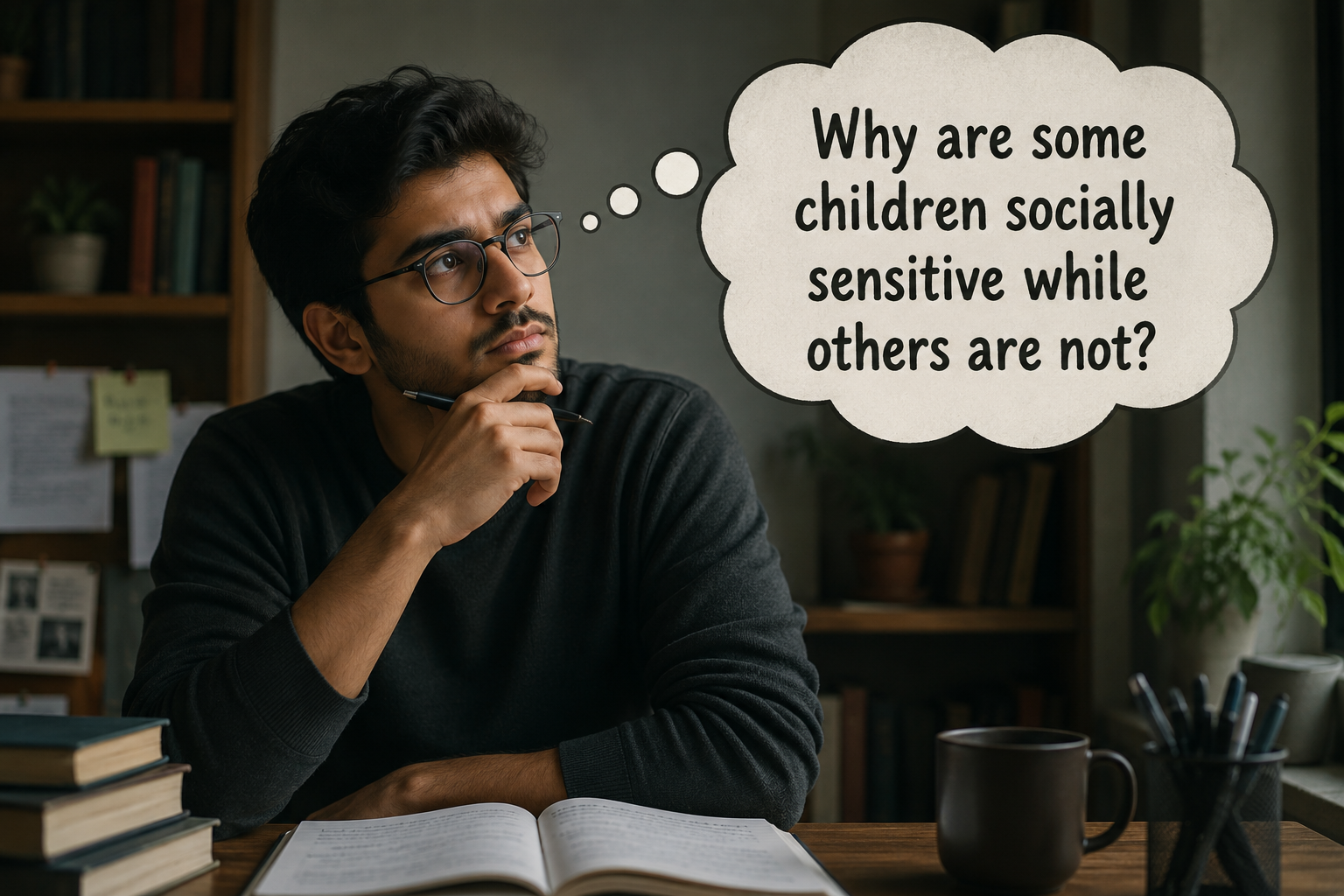
For many, it may have been a philosophical question, but for me, it was a practical one, as we were designing experiences for children who would become the future citizens of this country. In the programme, we were applying our own knowledge based on instinct and theory. Previously, we had not asked anyone about their social awareness or what might have contributed to it, questions such as: How did they get here? What made us the way we are?
The question started bothering me even more. This led me to experiment on myself, and I wrote an email to fifteen friends, all NIRMAN fellows, who had worked and studied alongside me. I asked them:
Can you list five things from your childhood (from school through 10th grade) that might have led you to become socially aware and active later in life?
Twelve replied, bringing their wisdom to the project I was working on.
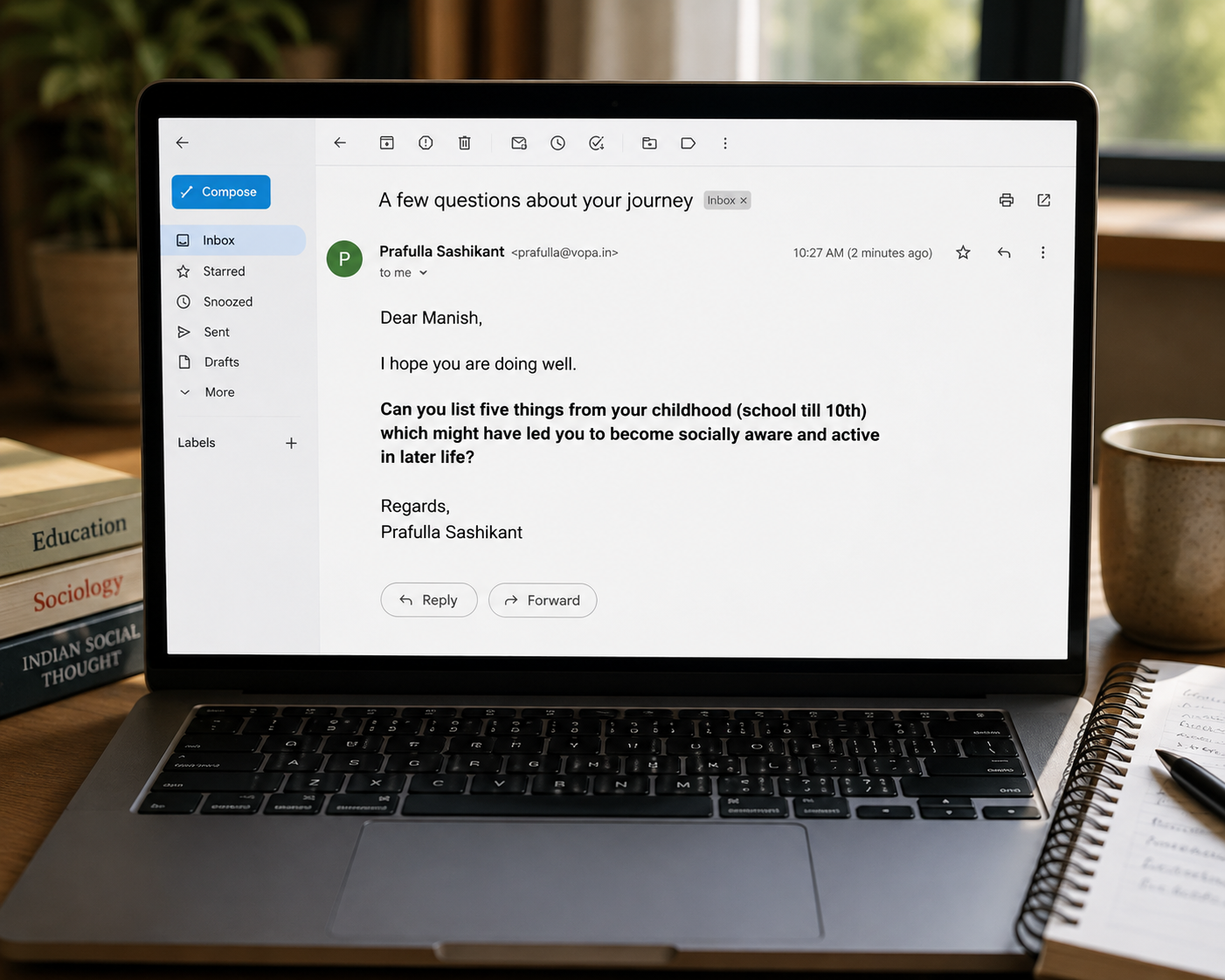
The Email was the first solution I designed
I still wonder: if I had asked my fellow mates if they could fill out a short survey for my research, perhaps that email would have got three replies, maybe four, or, optimistically, six. Each reply would have been merely a checklist task, a couple of sentences long.
Instead, I started with the line, “You are special,” and then explained how all NIRMAN fellows share a bond, a bond of empathy, which is worth sharing and acknowledging, and should not be taken for granted. I wanted to understand their journey, their story. I framed everything not as a survey, but as an invitation to look back at their own story.
The other most important thing was being honest and transparent about the purpose: MSO, schoolchildren, and designing better experiences. I substantiated this with one more line that helped more than anything else:
“It’s always great to look back, especially when it’s about our teenage years. :)”
The concluding line may have given people a reason to reply and brought back a sense of nostalgia, as this was for them too. The email was designed to make the other person feel valued and informed, while making the act of replying feel pleasurable and like being part of something, rather than an obligation.
What Came Back
Kalyani replied with six things (it was supposed to be five). She wrote about her father who have had helped accident victims, who came home with blood on his shirt. About a school principal who gave her a book called 'Jewels in the Dustbin.' In sixth standard she invited the local rickshaw driver to dinner at home (a stranger her parents did not know) her family served him without making a fuss about it. About an article on the Melghat malnutrition crisis that she read in class eight, and called the person working there.
She concluded her email with:
"बापरे जास्तच लिहिलं. मला. पण छान वाटलं जुन्या गोष्टींची उजळणी करायला. एकदम लहानपणी त चालत गेले. "
(Oh my God, I wrote way too much. But it felt good to go back to those old things. It took me right back to childhood)
Dr. Dharav, a psychiatrist, sent a thoughtful and well-structured response. At the end, he added something I hadn't asked for. He suggested that in future research, I shouldn't just ask people what had influenced them, but also which influences had mattered the most and which had mattered only a little. As he put it, "Otherwise, we might list some things simply to complete the number of five." It was an unsolicited suggestion to strengthen my methodology. That kind of feedback only comes when someone is genuinely engaged with the work and wants to help make it better.
And then there was Atul. Who did something that the others did not. He told me the truth. He wrote: "I really do not see anything in my past which has impacted me deeply. I can't say some books shaped me; I read my first book in engineering. I never encountered any shattering or moving societal problems other than those which are prevalent in our society." And yet Atul is one of the most socially conscious people I know. Surprisingly, he struggled to explain why. His response was long, reflective, and full of self-questioning. He suggested three possible influences from his childhood, only to question each one almost immediately. It was the most honest email in the batch not because it offered clear answers, but because it admitted uncertainty.
Reading his response taught me something the other eleven couldn't. Not every socially conscious person can trace their values back to a single defining moment, a particular book, or an inspiring mentor. Sometimes there is no neat origin story. Social sensitivity seems to accumulate gradually, through many small experiences that become meaningful only in hindsight.
Dr. Aakash lost his mother when he was just seven years old. His maternal uncle and aunt stepped in to raise him, a kindness he considers one of the greatest fortunes of his life. That experience also made him deeply aware of the plight of orphaned children who have no such support system. Growing up in a village where the nearest tertiary hospital was four kilometres away, he witnessed first-hand challenges of accessing healthcare. That reality inspired him to pursue medicine and eventually become a doctor.
Kalyan wrote about his grandfather, a kirtankar who made him perform Bharud at the annual village fair, who used to read Tukaram's Abhang every morning, and who one day refused to answer a question. Kalyan had asked: why does Tukaram say 'be as you are, be content' when there are beggars and hungry people all around? How does that apply to them? His grandfather just said: search for yourself, you will find it. Kalyan wrote: "It took me 6–7 years to find my answer. But the quest for it changed the course of my life significantly."
I read that email twice.
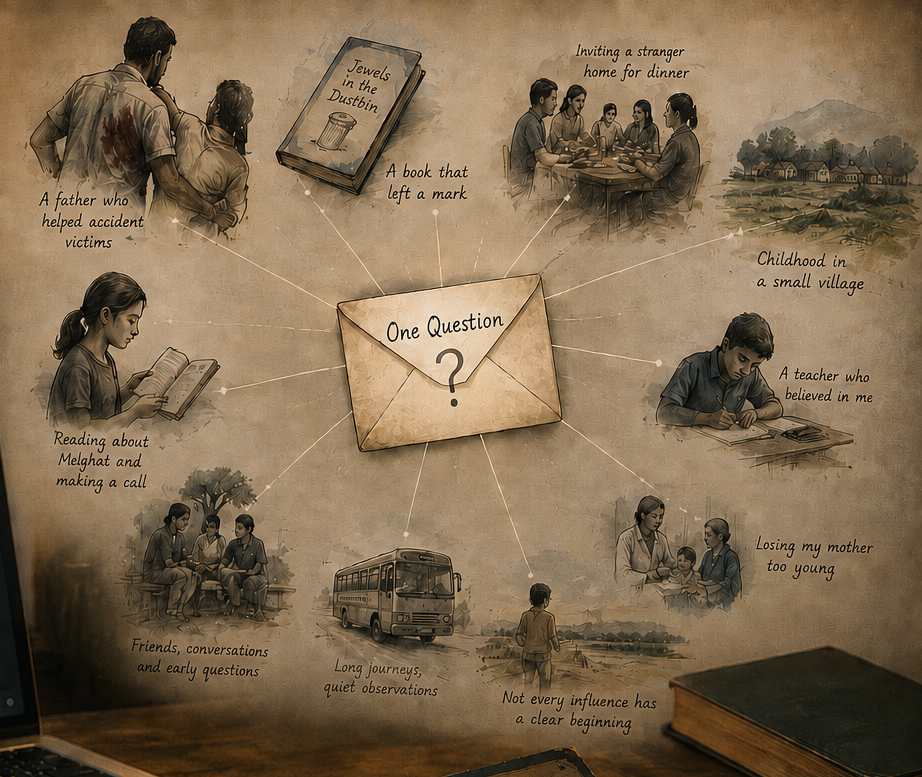
What the Twelve Emails Said, Taken Together
When I read all twelve responses together, not individually but as a whole, three patterns were consistent which were impossible to ignore.
First, family conduct. Eleven of twelve people traced their social sensitivity to at least one parent or family member. But here is the important part: nobody said their parents taught them values. Nobody mentioned a lecture or a family rule. What they described was something they watched. A father who returned money a shopkeeper had accidentally overpaid. A mother who chose a poorly paid social job over a well-paid career job. An aunt who was a nurse and came home and explained her patients' lives at the dinner table. Children absorbed values through observation, not instruction. That is a very different thing, with serious implications for how you design anything that is meant to change what children believe.
Second, books. Nine of twelve mentioned reading as formative. And not one person mentioned a textbook. Not a single syllabus topic. What appeared were specific titles: Shyamachi Aai, Gotya, Mandeshi Manasa, books on Dalit literature, a biography of Vivekananda. Almost every book that mattered had been given by someone, a trusted adult who pressed it into the person's hands at the right moment. Gifting was as important as reading.
Third, the most surprising. Almost nobody cited school as an institution. Sensitive individual teachers appeared: Nikhil mentioned 'a few periods by sensitive teachers,' Shivprasad wrote about a teacher called Rake sir who narrated short biographies of good people after morning prayers. But the curriculum itself? The syllabus? Zero. What shaped these twelve people was not school. It was what school accidentally created space for: a competition, a teacher who went off-script, an exhibition, a jungle reading camp.
Social sensitivity is not taught. It is absorbed: through proximity to suffering, through watching an adult choose integrity when no one is watching, through a book that makes you feel what you have never lived.
What I Am Not Claiming
I want to be honest about what this exercise was and wasn't.
Fifteen emails. Twelve responses. All people who were already in NIRMAN, already self-selected as socially motivated young adults. This was not a scientific study. The sample was tiny and skewed. The responses were retrospective, meaning people were telling you their story as they understand it in adulthood, which is not the same as what actually happened in childhood. I had to be aware of all of this. And I still think it was more useful than not doing it.
Because the alternative was to design a children's programme based entirely on theory, on papers written by people who may never have been to Parbhani or a village outside Jalna. This exercise gave me something a theory cannot, a pragmatic view that specific stories, from real people which are grounded in lived experience. That is a different category of knowledge. It does not replace data. It gives data a direction to look in.
What It Did to the Relationships
I want to mention something that I did not anticipate.
The people who replied became, in some small but real way, closer to me because of this exchange. Kalyani wrote to me like she was reliving something real. Atul chose to be honest about not having a clean answer, which is the kind of honesty that takes trust. Kalyan trusted me with a question he had carried for years. Dharav gave me unsolicited methodological advice, which a person only does when they think the work genuinely matters.
None of that would have happened with a Google Form. There is something about asking a real person a real question, in a personalized way that clearly shows you thought about them specifically, that explains the purpose, and that gives them something in return, that creates a different kind of connection. It is slow process, however twelve honest, specific, human responses are worth more to your thinking than a hundred checkbox answers.
Why I Am Telling You This?
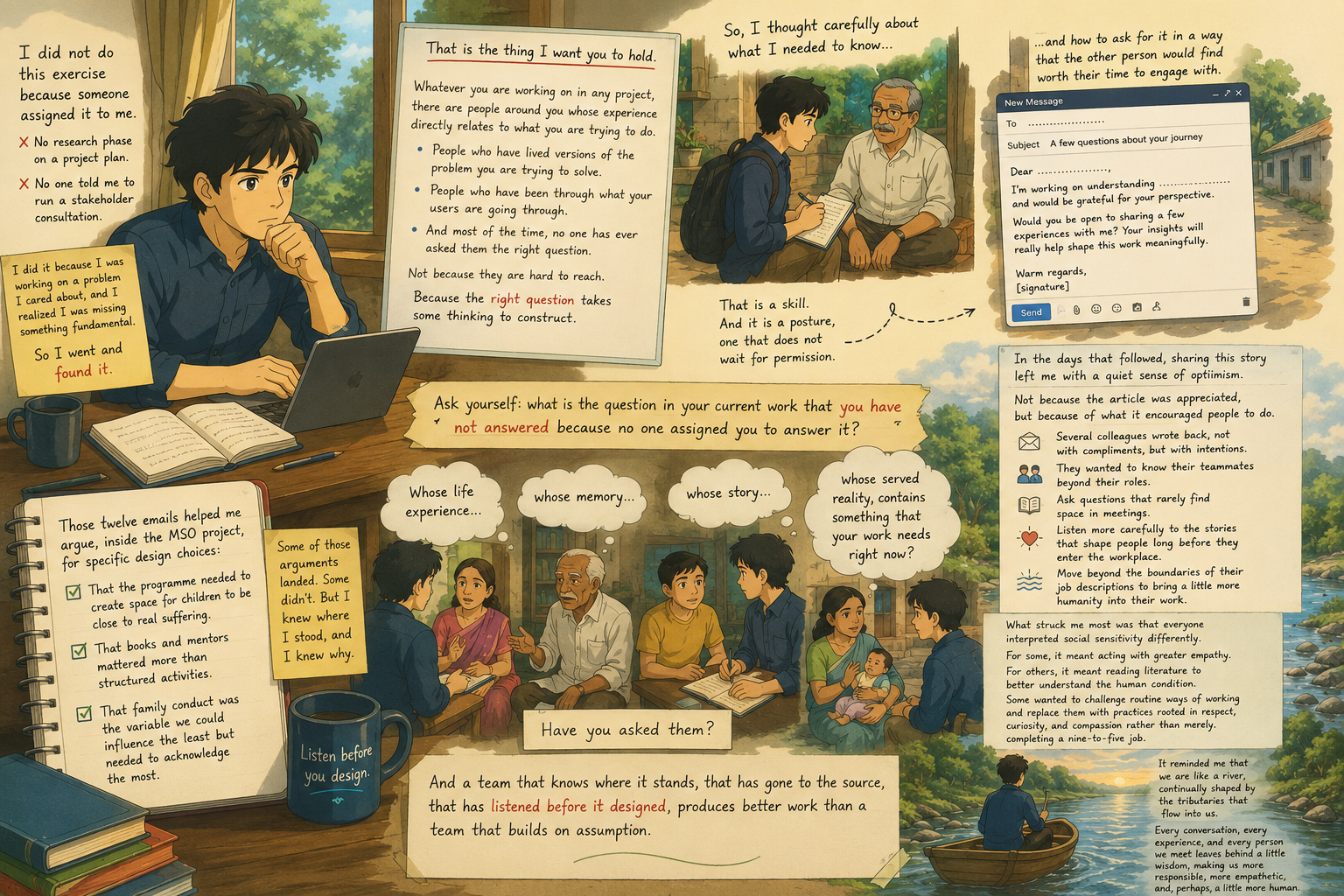
I did not do this exercise because someone assigned it to me. There was no research phase on a project plan. No one told me to run a stakeholder consultation. I did it because I was working on a problem I cared about, and I realized I was missing something fundamental. So I went and found it.
That is the thing I want you to hold.
Whatever you are working on in any project, there are people around you whose experience directly relates to what you are trying to do. People who have lived versions of the problem you are trying to solve. People who have been through what your users are going through. And most of the time, no one has ever asked them the right question. Not because they are hard to reach. Because the right question takes some thinking to construct.
The email I wrote in 2015 worked not because I was a trained researcher. It worked because I thought carefully about what I actually needed to know, and then I thought about how to ask for it in a way that the other person would find worth their time to engage with. That is a skill. And it is a posture, one that does not wait for permission.
Ask yourself: what is the question in your current work that you have not answered because no one assigned you to answer it? Whose life experience, whose memory, whose story, whose served reality, contains something that your work needs right now? Have you asked them?
Those twelve emails helped me argue, inside the MSO project, for specific design choices: that the programme needed to create space for children to be close to real suffering, that books and mentors mattered more than structured activities, that family conduct was the variable we could influence the least but needed to acknowledge the most. Some of those arguments landed. Some didn't. But I knew where I stood, and I knew why. And a team that knows where it stands, that has gone to the source, that has listened before it designed, produces better work than a team that builds on assumption.
In the days that followed, sharing this story left me with a quiet sense of optimism. It was not because the article was appreciated, but because of what it encouraged people to do. Several colleagues wrote back, not with compliments, but with intentions. They wanted to know their teammates beyond their roles, ask questions that rarely find space in meetings, and listen more carefully to the stories that shape people long before they enter the workplace. Others spoke of moving beyond the boundaries of their job descriptions to bring a little more humanity into their work. Their responses reminded me that every person carries a unique wisdom, shaped by experiences that often remain unseen.
What struck me most was that everyone interpreted social sensitivity differently. For some, it meant acting with greater empathy. For others, it meant reading literature to better understand the human condition. Some wanted to challenge routine ways of working and replace them with practices rooted in respect, curiosity, and compassion rather than merely completing a nine-to-five job. It reminded me that we are like a river, continually shaped by the tributaries that flow into us. Every conversation, every experience, and every person we meet leaves behind a little wisdom, making us more responsible, more empathetic, and, perhaps, a little more human.