
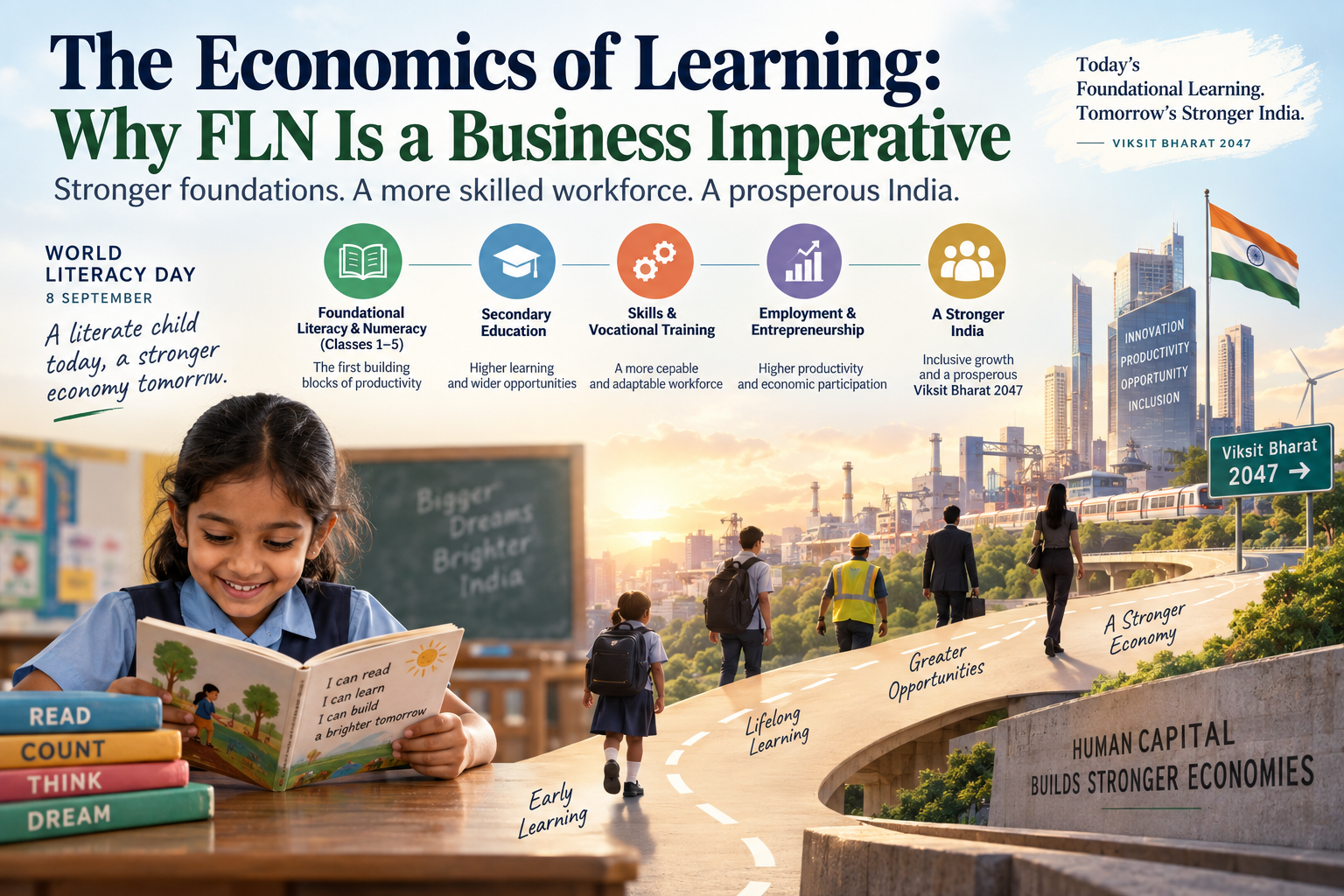
The Economics of Learning: Why FLN Is a Business Imperative
A child learning to read may not look like an economic event, but it is the beginning of one. The ability to read, count and reason today shapes how people learn, work and adapt tomorrow. For India, where today’s children will become tomorrow’s workforce, foundational learning is an investment in human capital. FLN is not merely an education outcome it is the foundation of economic participation, productivity and growth.
The Economics of Learning: Why FLN Is a Business Imperative
Last week, as we mark World Literacy Day (8th September), it is an opportunity to look beyond literacy as an educational outcome and recognise it as a foundation of economic capability. Literacy is not an isolated educational outcome; it is the foundation upon which individuals acquire knowledge, make decisions, engage with institutions and participate in economic life. India holds a demographic edge that few economies still possess: a population overwhelmingly of working age, with a fertility rate of 2.0 (NFHS 6), slightly below the replacement fertility rate of 2.1. India is moving towards the kind of stability more mature economies have already reached. However, around 25% of the population is below 15 years of age (NFHS 6). This demographic advantage comes with a responsibility for the formation of human capital. The children who constitute a quarter of India’s population today will form a significant part of its workforce over the next two decades, making the quality of their foundational learning an economic question rather than merely an educational one. One of the lessons from the 1991 liberalization was that opening an economy and creating new opportunities does not, by itself, guarantee that the workforce is equipped to take advantage of the technology and the nature of work that are changing rapidly. That raises the real question: when does the young workforce actually begin acquiring technical knowledge: at junior college, at university, or during on-the-job training at the organisation? The answer, in fact, lies at the primary and upper-primary stages, from classes One to Five. The more a child is invested in during this developmental window, the more he or she is eventually able to contribute to the country’s growth. This is where Foundational Literacy and Numeracy (FLN) is vital: the ability to read a simple passage and perform basic arithmetic, which may seem like elementary capabilities, but are the first building blocks of economic participation.
The economic significance of FLN extends beyond the primary classroom; it determines how effectively an individual can go on to acquire skills, respond to information, and participate in an increasingly complex economy. Adam Smith's central insight in The Wealth of Nations was that ‘specialization increases productivity’, but specialization happens when workers actually learn and perform the tasks assigned to them. A factory worker, for instance, needs to read operating instructions, interpret measurements, understand a production dashboard, spot an error, and learn a new process when technology changes. What looks like a basic educational capability at age eight becomes an economic capability at age twenty-eight. This is why foundational learning should be understood as the beginning of the productivity chain, the platform on which secondary education, vocational training, higher education, and workplace learning are all built.
India's own experience with this challenge is instructive. In 2024, 23.4 per cent of Grade III children enrolled in government schools could read a Grade II-level text, up from 16.3 per cent in 2022. Among Grade V children, the proportion rose from 38.5 per cent to 44.8 per cent over the same period. However, more than half of Grade V children in rural government schools still could not read a Grade II-level text. Similarly, nearly three-quarters of Grade V children in rural government schools still could not solve a basic division problem.
This gap matters in the workplace, as basic numeracy allows people to compare prices, understand interest rates, assess quantities, and make basic economic choices. The capability that education creates has both an economic and a social dimension. That becomes clearer when set against India's ambitions in manufacturing, formal employment, entrepreneurship, digital services, and technology-intensive industry, all expanding even as businesses face rapid technological change. These ambitions require investment in physical and financial capital, but human capital is not built in isolation; it needs capabilities, which individuals have to develop. Foundational learning, seen this way, is an investment in human capital; it increases the capabilities and skills embodied in individuals, raising their productivity, expanding their earning potential, and improving their ability to adapt to changing economic opportunities. Literacy gives a person access to information that would otherwise stay out of reach; for the millions who run small businesses, work as self-employed individuals, farm, or operate in informal markets, foundational numeracy has immediate, everyday economic relevance. A child with strong FLN carries a real advantage into every subsequent stage: vocational training, technological change, and higher education, because the basic mechanisms for acquiring new knowledge are already in place. FLN, in that sense, is not preparation for the next grade; it is preparation for a lifetime of learning.
If India's economic challenges are raising productivity, creating better jobs, improving technology adoption, strengthening entrepreneurship, and enabling workers to adapt to structural change, then foundational learning belongs squarely inside that conversation, not before it. Businesses have a direct stake in the quality of the future workforce, even though the investment in that workforce is made years before anyone enters a factory or an office; a firm can invest in employee training, but it cannot be expected to compensate indefinitely for weaknesses accumulated across an entire childhood. The factories, enterprises, and technologies of tomorrow will need people who can learn, adapt, and judge well, and that capacity is first built when a child learns to read a sentence, understand its meaning, and make sense of a number. What looks like a modest classroom achievement is, in economic terms, the start of a much longer chain of human capability and productivity.
The real economic wealth of a country is not created only in its offices, factories, or universities; its foundations are laid much earlier, in the primary classroom. The children sitting there today will constitute the workforce, entrepreneurs, professionals, and citizens of 2047, and the capabilities they acquire now will shape the economy they inherit and eventually build. India's vision of Viksit Bharat 2047, therefore, cannot be separated from what happens in its primary schools today. An economy is ultimately measured by its output, but the foundation of that output lies in what its people are capable of learning, adapting, and doing. Foundational literacy and numeracy should consequently not be treated as merely the first chapter of an education agenda, to be followed by the "real" economic agenda of skills, jobs, technology, and productivity. FLN is itself an economic tool the first investment in the human capital on which those ambitions depend. If Viksit Bharat 2047 is to be more than a target for higher GDP and greater investment, it must also be an economy in which people possess the capabilities to create, participate in, and benefit from that growth. The most consequential economic investment India can make today, therefore, may be one whose returns will not appear on a balance sheet for years: ensuring that every child has the foundational capabilities to learn what the economy of 2047 will demand.