Not So Obvious Expertise
The expertise from years of experience is respected, but the fresh perspective of a novice drives unexpected breakthroughs. A reflection on how both kinds of expertise shape work in foundational literacy and numeracy programmes like NIPUN Maharashtra, and what it takes to build lasting change in Maharashtra government schools.
Story 1
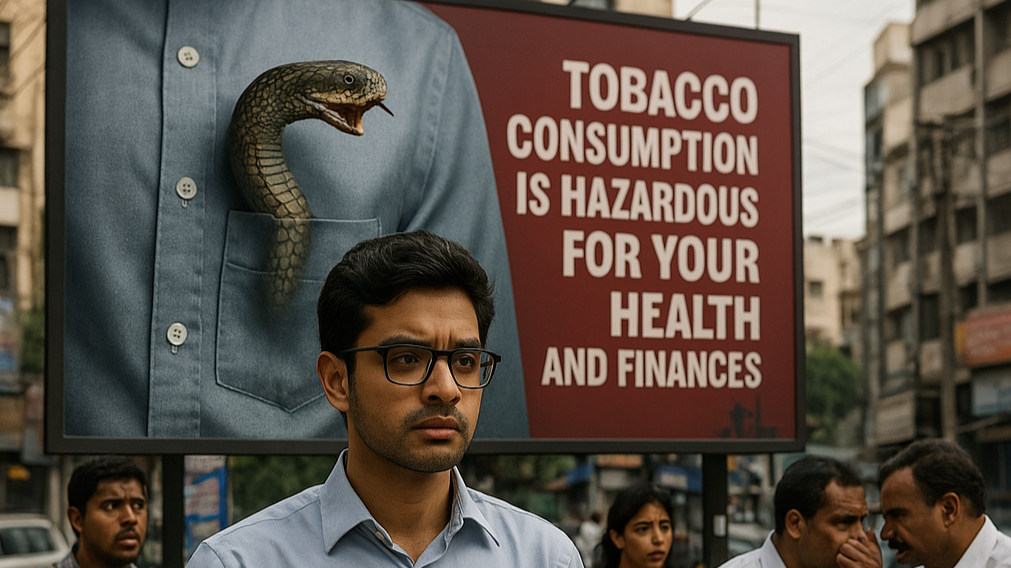
Tanish was an early-career professional who had recently joined the design team of a reputed marketing firm. All his teammates had been with the company for a few years, making Tanish the most junior person on the team. The company had just acquired the World Health Organization as a client. This was a major win for the company because WHO, in partnership with the central government, planned to run a nationwide campaign to educate youths about the ill effects of tobacco consumption, which would generate substantial revenue for Tanish’s company. Tanish’s team was tasked with designing educational posters to be displayed across major cities in India.
After multiple rounds of brainstorming, they finalized one concept: a snake emerging from a man’s pocket with the following message at the bottom of the poster: “Tobacco consumption is hazardous for your health and finances”. Everyone was happy with the subtle and creative idea; they felt that preaching to youths on this topic was more likely to backfire, and that an indirect approach was the best way to go. To test whether the posters resonated with their target audience, the youths, they decided to pilot it in Hyderabad. They meticulously scouted and rented billboards at prime locations across the city and displayed the posters within a few days. To assess audience reaction, Tanish and his teammates spent a day near the billboards, interacting with passersby to understand what messages people took away and whether the intended perception of the brand was being created.
To their disappointment, most people didn’t even understand what the billboard was about. The text was too small to read from a distance, and while the image was visible, it was too abstract. Most people were confused about the message. Tanish’s manager arranged a meeting with the company’s CEO and COO to discuss the pilot’s findings. During the meeting, Tanish candidly admitted that the billboard was too abstract, and the key message was not reaching the target audience. The CEO and COO reacted harshly. They reprimanded the entire team, including Tanish’s manager, who stayed silent throughout the meeting, for wasting company resources and not living up to the firm’s reputation.
Tanish was bewildered. The purpose of a pilot, he thought, was to assess whether something worked, and in that sense, it had done its job. During a cigarette break, he overheard some senior colleagues muttering that Tanish was immature and didn’t know what should or shouldn’t be shared with senior leadership. He had believed that being honest about the results was expected. Slightly hurt, Tanish wondered if he should ever share critical insights with anyone in the company.
Story 2
Saachi had recently completed a master’s degree in economics from one of India’s premier institutes and joined a public policy research organization. Her role involved designing and executing mixed-methods research to evaluate novel interventions in the health and education domains developed by both for-profit and non-profit clients.
In her first assignment, she worked on a project evaluating the potential of a WhatsApp-based intervention to improve children’s early numeracy and literacy in rural Uttar Pradesh. The intervention had been designed by a non-profit partner regarded as an expert in the education sector. Children’s education was close to Saachi’s heart, and she felt deeply motivated to contribute meaningfully. Over the next few months, she worked closely with her supervisor and senior researchers to conduct baseline surveys and semi-structured interviews with the parents of study-participant children.
The data collected by Saachi’s team revealed that the intervention wasn’t working as intended. The skewed distribution of mobile usage time along gender lines in Indian families and parents’ reluctance to give mobile phones to young children for learning were undermining the intervention’s impact. Saachi believed it was critical to communicate these insights to the non-profit partner so they could address the issue.
A meeting was scheduled to discuss the findings. In the meeting, as Saachi progressed through the slides, she sensed discomfort in the room, especially among the senior members of the non-profit organization. They began questioning her research methods in a dismissive tone and made passive-aggressive remarks suggesting that the problem lay in her research design, not in their intervention.
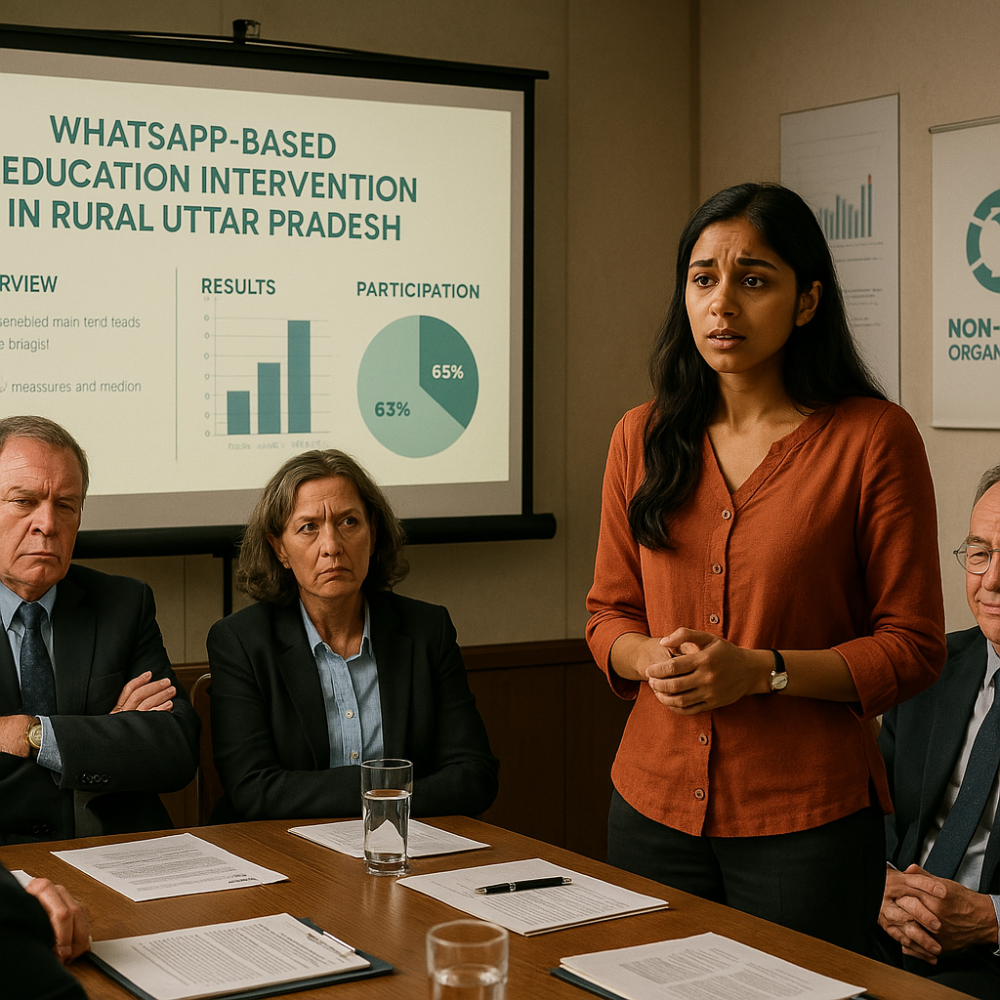
Saachi was taken aback. Until then, her team had maintained a cordial relationship with the non-profit, and she had assumed there was a shared goal to make the intervention work. She believed it was her responsibility to identify gaps so they could be addressed on time. But as the meeting unfolded, she found herself stammering. The senior non-profit staff, sensing her discomfort, offered condescending reassurance that she should not be afraid to share her thoughts. She finished the presentation and left the meeting wondering whether she should ever speak her mind in front of seniors again.
Afterthought
While the characters in these stories are fictitious, their experiences are not. Time and again, firms. whether for-profit companies, non-profits, or government bodies. dismiss the thoughts and ideas of new and inexperienced members. It may seem logical to give more weight to experienced opinions. After all, senior individuals have worked longer within the system, have a better understanding of organizational culture, and are more familiar with institutional priorities. However, relying too heavily on expertise acquired through experience can stifle creativity and contribute to a bloated organizational culture.
I don’t mean to dismiss the importance of experience. Experienced employees often need less training, make quicker decisions, and can remain composed in challenging situations. But the limitation of such expertise is that it is often too narrow. Our personal experiences represent only a tiny fraction of the complex, ever-evolving reality we operate in. What wasn’t possible or prudent at one time may become the best approach later. Experience is hard-won, shaped by mistakes and frustrations, which is why those who possess it are often the most resistant to changing their views or adapting to new realities. That is why, along with an experienced core, organizations should have a meaningful share of young professionals and create an environment where they are encouraged to share and test their ideas.
At VOPA, we have consciously worked to give young people space to voice and experiment with new ideas. A recent experience further strengthened our confidence in this approach. We work in the education and health domains in Maharashtra and have a Research, Monitoring, and Evaluation (RME) team responsible for collecting, analyzing, and reporting data on our projects. Traditionally, the team used pen-and-paper surveys, followed by a three-to-four-week process of manual coding and data entry to convert the information into an analyzable form. A few months ago, we brought an intern into the team, a 20-year-old in the final year of his bachelor’s degree. His college allowed final-year students to work full-time, provided they managed their academics and attended essential sessions.
After observing our tedious manual process, the intern suggested using Optical Mark Recognition (OMR) technology for data collection. OMR is used to detect and capture human-marked responses on paper forms, such as filled bubbles or checkboxes. It scans documents and identifies where marks absorb more light, allowing the system to record selected responses. Though I was aware of the technology, I was skeptical about its usability in our context, its accuracy, cost-efficiency, and the risk of disturbing a system that already worked.
Still, I decided to give it a chance. I asked the intern to write a proposal outlining how the RME team could use the OMR technology and what efficiency gains we could expect. I also asked him to test the technology with a few hundred respondents. Since this was substantial work, I suspected he might drop the idea, and I didn’t expect much support from senior team members either – why would they change something that worked? To their credit, the intern, the RME Officer, and the RME Associates worked together, wrote the proposal, and piloted OMR sheets with a few hundred students in one of our partner schools.
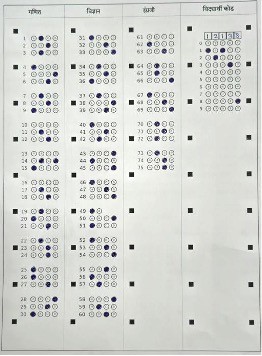
Sample OMR Sheet
The teachers and students welcomed the change. It simulated a real entrance exam experience, which they believed would help students prepare better for competitive exams. After the successful pilot, we rolled it out for our next large-scale survey. As a result, the data entry time was reduced from three weeks to just three or four days, with very high accuracy. The technology was also incredibly affordable, costing only around 500 rupees a month, making it ideal for a resource-constrained non-profit like ours. While this was a small win in the bigger picture, I couldn’t help but admire the intern’s creativity and the rest of the team’s humility. They didn’t let their designations or experience get in the way of implementing a promising idea from a novice. I wonder what else organizations can achieve by encouraging young professionals.
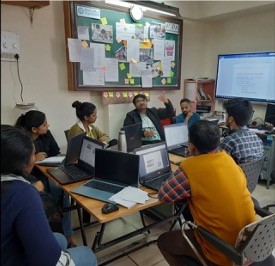
Interacting with young professionals in a team meeting at VOPA
The expertise that comes from years of experience is visible and respected. But there is another kind of expertise, less obvious and often underestimated, that comes from being a novice, untethered to past patterns and more open to what’s possible. Before starting my own non-profit, I worked with and interacted with friends and colleagues across various sectors and organizations. Time and again, I have seen many Tanishs and Saachis gradually fall silent, letting go of their unique perspective and adopting sycophancy to fit in. Experience is valuable, but in my observation, the scale is disproportionately tilted in favor of experience in Indian work culture. It is high time organizations, especially non-profits, gave young people the space to test their ideas. Otherwise, we risk remaining stuck in a version of the world that no longer exists, and worse, becoming content with it.