Happy Teachers Day- Integrating Technology with Pedagogy
Imagine a teacher trying to understand the learning level of every child in her classroom. She knows some students are struggling, but knowing exactly who needs help, what they are struggling with, and whether they have improved is far harder. For generations, teachers have relied on observation, classroom responses and periodic tests to make these judgments. Today, technology is beginning to give them something they have rarely had before: a continuous, detailed view of how each child is learning.
Happy Teachers Day- Integrating Technology with Pedagogy
A teacher notices that a student who has been quiet throughout the lesson is still struggling to read a simple sentence. She asks the child to try again, changes the way she explains the word, and gives the child another example. A few minutes later, the child gets it right. It is a small moment, easily missed in the rhythm of a school day. But this is teaching at its most fundamental: knowing where a child is, recognising what they need next, and adapting accordingly
The role of the teacher as a guide for individual learning is not new. Krishna trained Arjuna. The Buddha, after his enlightenment, spent the rest of his life walking from town to town simply to teach. Across civilizations, the teacher has always been the person who watches one student closely enough to know exactly what they need next.
In ancient India, the teacher was both mentor and evaluator, and no one was better placed to judge a student's progress than the person who taught them every day. But as enrollment expanded, that relation between teacher-students became harder to sustain. Teachers today carry responsibilities far beyond the classroom, and their time with students is genuinely limited: by one estimate, accounting for summer break, winter break, weekends, government holidays, and teachers' own leave, a teacher spends roughly 200 days a year actually with students. Within those 200 days, they're expected to complete the entire cycle of teaching and assessment.
This is what makes teaching such a demanding profession. A teacher is expected not only to deliver a lesson, but to notice who understood it, who is falling behind, and why. One child may need another explanation; another may need a different example; a third may already be ready to move ahead. The best teachers have always done this instinctively, observing, assessing, and adapting their teaching to the child in front of them. That is also what Teachers’ Day asks us to recognize: the teacher’s work is fundamentally about seeing the individual learner. Technology cannot replace that relationship. But it can help a teacher see more clearly, particularly when a classroom has dozens of students and hundreds of learning needs competing for attention.
For a government trying to track Foundational Literacy and Numeracy (FLN) across an entire state, this is close to impossible. The National Education Policy sets a clear target: every child should achieve basic foundational literacy and numeracy by Grade 3. The Centre's response is NIPUN Bharat (National Initiative for Proficiency in Reading with Understanding and Numeracy). But translating that mandate into actual, granular monitoring has been a persistent challenge.
Reports like ASER and PARAKH capture the reality of learning outcomes, but they are sample-based surveys. They can tell a state how it's doing in aggregate they can't tell a specific school, or a specific taluka, what to do differently on Monday morning. That granular, school-level intervention is the harder problem, and it's one most states haven't solved. Even where third-party assessments are commissioned, the logistics of conducting them, then compiling results, mean most governments manage only one assessment cycle a year. By the time results are analyzed and interventions designed, students have often already been promoted to the next grade the learning gap widens, and children who don't understand what's being taught risk disengaging from the subject, or from school itself.
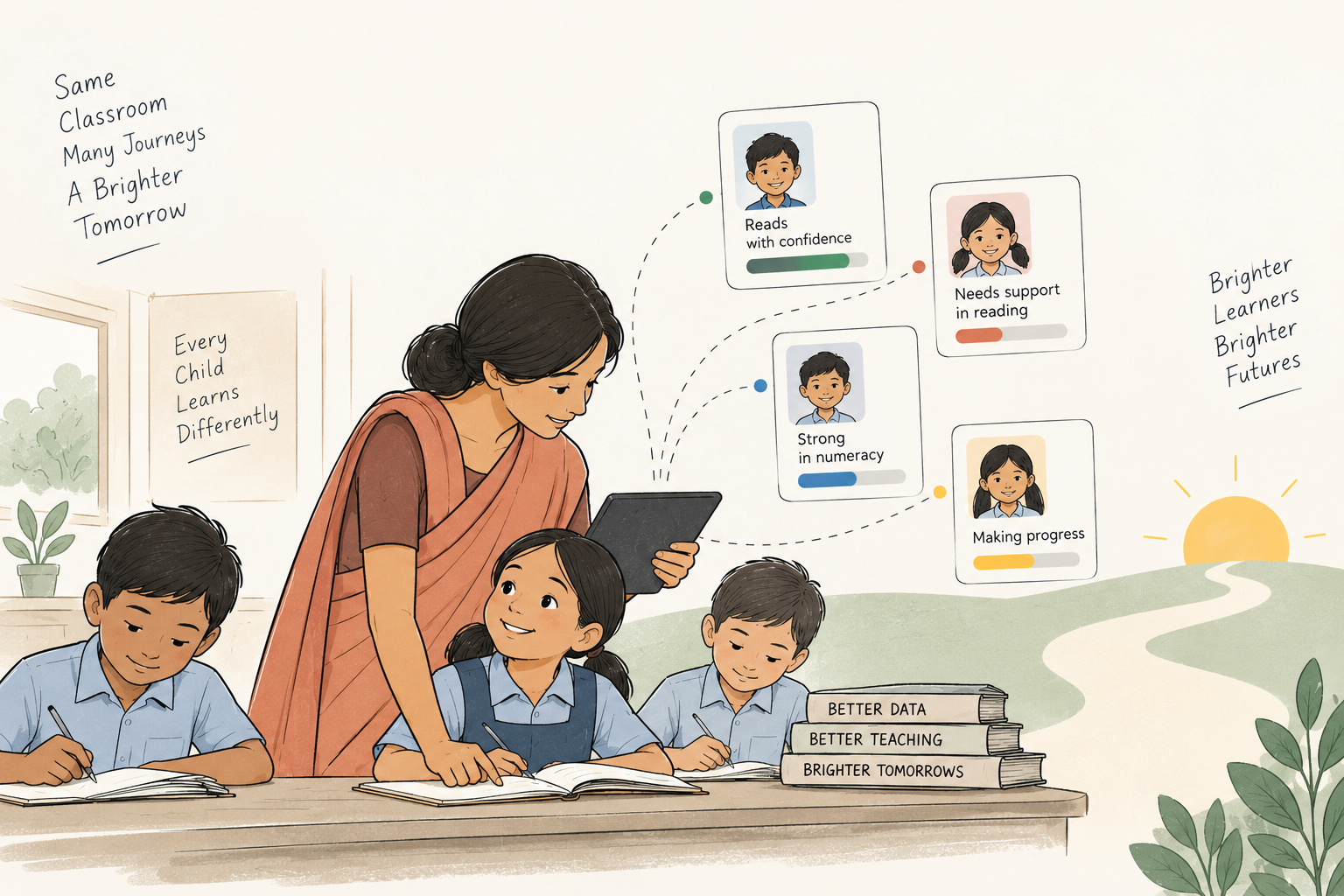
For a teacher, however, identifying a learning gap is only the beginning. The real question is: who needs help, with what, and right now? A teacher cannot meaningfully adapt instruction for a child whose learning needs remain invisible. This is where good data can become an extension of good pedagogy, not another administrative burden, but a way of giving teachers a clearer picture of the children they teach.
This is the promise of technology when it is designed around the teacher: not to teach instead of them, but to give them better information with which to teach.
What Maharashtra Did Differently
Through the NIPUN app, Maharashtra has four assessment cycles in just six months, not a sample survey, but a census covering over 85% of the students enrolled across Classes 2 to 5 across Maharashtra. None of this would have been possible without teachers carrying it out.
The mechanism is simple, and it runs entirely through the teacher:
Reading comprehension is assessed using an AI model that listens to a student read aloud and scores them accordingly.
Numeracy is assessed by having the teacher photograph a student's worked solution; the AI model reads the answer and scores it.
Because the questions are AI-generated, different students can be tested on the same competency through different question sets, reducing copying and giving a truer picture of individual understanding. The teacher's role shifts from single-handedly grading to monitoring: both the teacher and the headmaster can see, in near real time, how every student is performing. Because the assessments are continuous rather than annual, teachers get ongoing opportunities to change their pedagogy for the students who need it, long before a school year is lost.
The Teacher's Role Hasn't Shrunk. It's Sharpened.
There's a way to think about what's changed. The old image of the teacher-as-guru was a solitary one: one mentor, one disciple, years of undivided attention. It's a beautiful image, but it doesn't scale — and it was never available to most children in the first place. What Maharashtra's teachers have now is closer to a coach with a scoreboard: not less involved in each student's progress, but able to see every student's form, continuously, instead of just one.
This Teachers’ Day, therefore, is an opportunity to recognise something fundamental about the teaching profession: good teaching has always been personal. It begins with knowing that every child learns differently and that the teacher’s job is to understand where each child is and help them take the next step. What has changed is that technology can now make that understanding possible at a scale that was once unimaginable.
This is not a story about AI replacing the teacher’s judgment. It is a story about giving teachers better visibility into the learning of their students and, in turn, more time and information to do what teachers have always done best: notice, understand, encourage and teach. For Maharashtra’s 1.6 lakh teachers, that may be the most meaningful role technology can play: not making the teacher less important, but making the teacher’s attention more precise, timely and effective.